A pun is a form of wordplay that exploits multiple meanings of a word or similar-sounding words for a humorous or rhetorical effect. Puns are everywhere—in jokes, advertising, social media, and literature.
By understanding the types of puns, you can craft witty captions, clever dialogue, or memorable marketing lines.
Pun Examples
- Time flies like an arrow; fruit flies like a banana.
- I’m reading a book on anti-gravity—it’s impossible to put down.
- I used to be a baker, but I couldn’t make enough dough.
- The bicycle couldn’t stand up because it was two-tired.
- I wondered why the baseball kept getting bigger—then it hit me.
- A boiled egg every morning is hard to beat.
- The math teacher has too many problems.
- The scarecrow won an award because he was outstanding in his field.
- I used to be a banker, but I lost interest.
- The dentist had a filling day at work.
Types of Puns in English
- Homophonic Puns – Words sound alike but have different meanings.
- Homographic Puns – Words are spelled the same but have different meanings.
- Compound Puns – Multiple puns used in the same sentence.
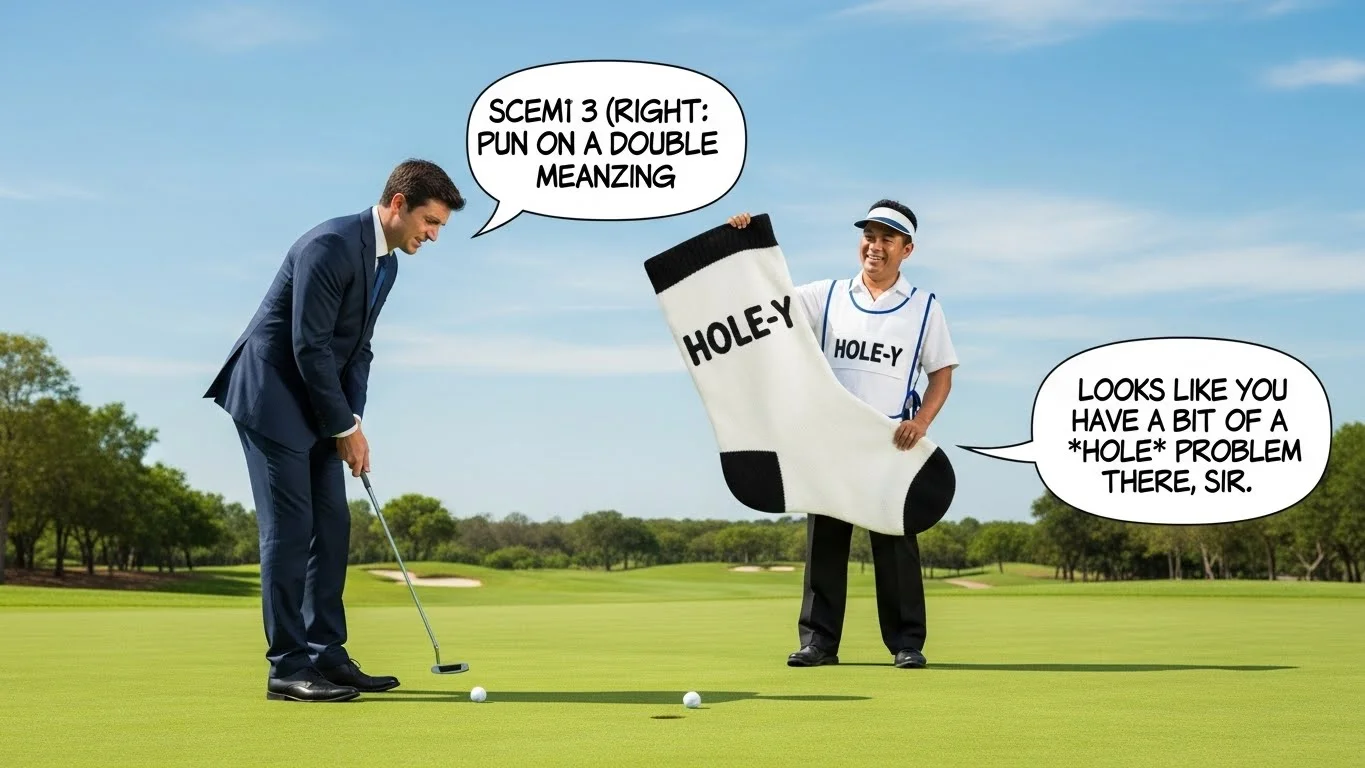
- Visual Puns – Humor created through images or symbols.
- Recursive Puns – Understanding one pun requires understanding another.
- Idiom-Based Puns – Play on common phrases and expressions.
- Double Entendre – A phrase with two interpretations, often humorous.
- Tom Swifties – Puns where the adverb relates humorously to the statement.
- Antanaclasis – Repetition of a word with different meanings.
- Malapropism Puns – Intentional misuse of similar-sounding words.
Types of Puns with Examples
- Homophonic Pun: “I used to be a baker because I kneaded dough.”
- Homographic Pun: “The duck said, ‘Bill me later.'”
- Compound Pun: “A bicycle can’t stand alone because it’s two-tired and lacks support.”
- Visual Pun: A picture of a bee with the word “Bee-lieve.
- Double Entendre: “Marriage is a fine institution, but I’m not ready for an institution.”
- Idiom Pun: “Lettuce celebrate!”
- Antanaclasis: “A good pun is its own reword.”
- Tom Swifty: “I love hot dogs,” Tom said frankly.
- Recursive Pun: “Infinity is not in finity.”
- Malapropism Pun: “He’s the pineapple of politeness.”
Types of Puns for Students
- Word Puns
- Sound-Alike Puns
- Animal Puns
- Food Puns
- School Puns
- Name Puns
- Rhyming Puns
- Idiom Puns
- Book and Reading Puns
- Sports Puns
Examples:
- “The pencil had a point.”
- “The cat was purr-fect.”
- “Orange you glad to see me?”
- “The student was ruler-ed by success.”
Simple Pun Examples
- Orange you glad I came?
- Bee yourself.
- Lettuce be friends.
- Donut worry, be happy.
- You’re tea-rific.
- Olive you.
- Have an egg-cellent day.
- Whale, hello there!
- Alpaca my bags.
- Paws and relax.
Types of Puns Funny
- Animal Puns – “What do you call a fish with no eyes? Fsh.”
- Food Puns – “Donut give up.
- Job Puns – “The electrician was shocked.”
- Weather Puns – “Thunderstorms are striking.”
- Music Puns – “That’s a note-worthy performance.
- Science Puns – “Atoms make up everything.
- Travel Puns – “I’m plane crazy.”
- Sports Puns – “That was a ball-istic game.”
- Holiday Puns – “Have an ice day.”
- Technology Puns – “I’m byte-sized but powerful.”
What Is Pun in Literature
- A pun is a figure of speech that creates humor or emphasis by using words with multiple meanings or words that sound similar but have different meanings.
- Writers use puns to entertain readers, create memorable dialogue, add wit, and sometimes reveal deeper meanings.
- Puns appear frequently in poetry, plays, novels, advertisements, and everyday conversation.
Example:
- In Shakespeare’s Romeo and Juliet, Mercutio says, “Ask for me tomorrow, and you shall find me a grave man.”
- The word “grave” means both serious and a burial place, creating a pun.
Ten Example of Pun
- I’m friends with all electricians—we have good current connections.
- The calendar’s days are numbered.
- I used to be a tailor, but it wasn’t a good fit.
- The stadium got hot after all the fans left.
- The garbage collector’s job is rubbish.
- I stayed up all night wondering where the sun went—then it dawned on me.
- The fisherman was hooked on his job.
- The clock factory workers worked around the clock.
- The shoe factory closed because it couldn’t sole-ve its problems.
- The baker’s jokes always rise to the occasion.

📝 Homophonic Puns (Sound-Alike Puns)
Definition: These puns rely on words that sound the same but have different meanings.
Examples:
I used to be a baker, but I kneaded dough.
Time flies like an arrow; fruit flies like a banana.
I’m reading a book on anti-gravity—it’s impossible to put down.
Tip: Great for spoken humor and clever captions.
🧩 Homographic Puns (Same Spelling, Different Meaning)
Definition: These puns use words that are spelled the same but have different meanings.
Examples:
I can’t bear the suspense.
The musician was well note-d in history.
The wedding was so knotty.
Tip: Works well in writing, signage, and clever headlines.
🎭 Compound Puns
Definition: Puns that combine multiple layers of wordplay in one sentence.
Examples:
I used to be a banker, but I lost interest—now I’m a checking account.
I’m reading a book about anti-gravity—it’s impossible to put down, I can’t let it slide, and I’m floating with excitement.
Tip: Best for witty writers who want multiple laughs in one line.
🐾 Visual Puns
Definition: Puns that rely on images or visuals instead of just words.
Examples:
A sign of a clock showing “Time Flies” with wings.
A picture of a cat wearing a crown labeled “Purr-incess.”
A carrot with sunglasses captioned “Carrot-top.”
Tip: Perfect for memes, social media, and advertising.
🐝 Homonymic Puns
Definition: Puns that use words that sound alike (homonyms) to create humor.
Examples:
“A bicycle can’t stand alone—it’s two-tired.”
“I’d tell you a chemistry joke, but I know I wouldn’t get a reaction.”
“I’m reading a book on anti-gravity—it’s uplifting.”
Tip: Great for spoken jokes and playful writing.
💬 Recursive Puns
Definition: Puns that reference themselves or need explanation to be funny.
Examples:
“I used a pun about recursion, but it referred to itself in the next line.”
“Did you hear about the pun about a pun? I can’t explain it; it’s self-referential.”
Tip: Perfect for nerdy audiences, programmers, or literature buffs.
🦄 Spoonerisms
Definition: A type of pun where initial sounds are swapped to create humor.
Examples:
You’ve hissed all my mystery → You’ve missed all my history.
Fighting a liar → Lighting a fire.
Better Nate than lever → Better late than never.
Tip: Fun for verbal wordplay, speeches, and improv.
🐦 Compound-Word Puns
Definition: Puns created by splitting or merging words to make double meanings.
Examples:
I’ve got a latte love for coffee.
You’re un-bee-lievable 🐝
Lettuce turnip the beat 🥬🎵
Tip: Excellent for social media captions, memes, and playful writing.
🏷️ Forced Puns
Definition: Puns that are intentionally stretched to make humor happen.
Examples:
I’d tell you a joke about construction, but I’m still working on it.
I wanted to be a baker, but I kneaded dough elsewhere.
Tip: Can be cheesy but endearing; great for dad jokes and casual humor.
🎨 Macaronic Puns
Definition: Puns that mix languages or dialects for wordplay.
Examples:
“Hola! I’m taco-ing about you!” 🌮
“C’est la pie!” 🥧
“Sushi you later!” 🍣
Tip: Fun for bilingual or international audiences.
🔁 Recursive Wordplay
Definition: A pun that depends on the audience knowing another pun.
Examples:
“I used a pun about recursion—it refers back to itself.”
“Did you hear about the joke about a pun? Wait… you need context.”
Tip: Works well for nerdy humor, social media threads, or literary jokes.
⚡ Paronomasia
Definition: The classic rhetorical pun where words are used with similar sounds but different meanings.
Examples:
“Time flies like an arrow; fruit flies like a banana.”
“I’d tell you a chemistry joke but I know I wouldn’t get a reaction.”
“I wondered why the baseball was getting bigger—then it hit me.”
Tip: Ideal for clever written humor or witty commentary.
🧩 Tom Swifty Puns
Definition: Puns where the adverb relates to the dialogue.
Examples:
“I’m reading a book on anti-gravity,” said Tom lightly.
“I lost my pencil,” Tom said pointedly.
“I can’t find my blanket,” said Tom warmly.
Tip: Perfect for kids’ books, writing exercises, or playful humor.
💡 Mixed Puns
Definition: Puns combining multiple pun types in one line.
Examples:
“I’m reading a book on anti-gravity—it’s impossible to put down, I’m floating with excitement, and I just can’t leaf it alone.”
“You’ve got a pizza my heart, and I’m totally crust-over-you!”
Tip: Great for social media captions or long-form humor writing.
🔑 Visual & Typographic Puns
Definition: Puns created through text styling or visual arrangement.
Examples:
Writing “man” in a mirror to say “nam”
Using emojis like 🐝 + 🐶 = “Bee-dog”
Drawing a pie with “Oh my pie!” above it
Tip: Excellent for Instagram, memes, and creative posts.
❓ FAQs
1. What makes a pun funny?
A clever double meaning, wordplay, or sound similarity that surprises the reader or listener.
2. Are all puns considered jokes?
Most puns are humorous, but some are just clever wordplay without a punchline.
3. Where can I use puns?
Social media, greeting cards, advertising, speeches, writing, and everyday conversation.
4. Why do some people hate puns?
Because they can be cheesy or forced, though often endearing.
5. Can puns improve creativity?
Yes! They encourage lateral thinking, linguistic creativity, and humor skills.
🎉 Conclusion
Puns are a delightful way to play with language. Whether you’re making people laugh with homophones, clever visuals, or word merges, puns are universal, fun, and endlessly creative.
Which type of pun is your favorite? 🐝🍕🐾
